Target operating model software
Don't just design your operating model. Bring it to life.
Target operating model (TOM) software that lets your operating model evolve as you run the business, with no redesign events needed. Keep your finger on the pulse of your organisation, and empower your people to own and improve how you operate. For CEOs and leadership teams of businesses of typically 50 to 500 people.
Used by leaders at tech companies like AtlasCloud, Healthstream, Volue and Synectics, and by service businesses like Building Materials Nationwide, Nayho and others. Software costs start at £300 a month.
Beyond software
Software as a service→Results as a service
A business that runs like clockwork.
Most software gives you a login and leaves you to it. We offer a high-touch service: we design a better system with your leadership team, run the target operating model alongside you, and leave it running.
- Design a better systemStrategy, processes, metrics, capabilities, roles and decision rights, designed together and held in one place.
- Run it with youWe run the early meetings, reviews and reporting, and coach your people until the rhythm is theirs.
- Leave it runningYour team owns it, the software keeps it connected, and the business keeps improving without us in the room.
Our team of consultants, fractional COOs and software. Not an extra burden on your team: we carry the set-up so they can focus on the decisions.
How the service works →The problem
Most operating models are designed once, then forgotten.
The consultants leave a long deck, and six months later the business runs exactly as it did before.
The tools don't help much. Enterprise architecture platforms are built for huge IT estates, and OKR tools stop at goals.
Your strategy is in one place, your goals in another, your org chart in HR, your KPIs in spreadsheets and your decisions in people's heads. Nobody can see how it connects, so nobody owns it.
You can't run a system you can't see.
What it's costing you
- Decisions get made
twice.Agreed in the meeting, re-argued in the next one, because nobody can see who owns the call. - The strategy loses to the urgent.Business as usual fills every week, and the work that would change things gets whatever's left.
- Your best people carry the gaps.They fix the handoffs nobody owns, until they're too stretched to stay.
- Margin leaks where teams meet.Waiting, rework and dropped handoffs never show on one report, so nobody fixes them.
What it's worth
What a better operating model is worth.
The design is only the means. Speed, growth and people are where you feel it first. Profit is where it shows up.
Speed
- Capabilities identified and built fasterKnow what the business must be good at, and build it in months, not years.
- Streamlined single- and multi-team processesFewer handoffs, less rework and less waiting between teams.
- Faster, better decisions, fewer delaysClear decision rights, so calls get made at the right level without the wait.
- Value created fasterGoals, ideas and experiments move from agreed to delivered at pace.
Growth
- Better customer experience that grows revenueJoined-up journeys that keep customers longer and bring them back.
- More innovation and creativityTime and a route for ideas, so the best ones become goals.
- Issues and opportunities managedProblems surface early, and every opportunity gets an owner.
People
- Better employee experienceClear roles and less friction, so people give more effort and stay longer.
- Less dependence on hiringGet more from the people you have before adding headcount.
Profit
Which shows up in the numbers.
- Reduced operating costsLess duplication, delay and waste, straight to the bottom line.
- Higher revenue per employeeThe sum of everything above, and the number boards and investors watch.
Brought to life in software
A target operating model management system. No spreadsheets, slide decks or extra meetings: a living system to run your business in.
How it fits together
Your whole business, connected.
Every part of how your business runs has a place, and every place links to the rest.
- StrategyOne-pagers, pillars, themes or BSC perspectives, in your own language.
- GoalsOKRs, WIGs, Rocks or SMART goals, each traced to a strategic driver.
- Strategy vs business as usualTeam Scorecards keep BAU off your strategic goals, so you can see how much effort is moving the business forward.
- MeasuresKPI trees showing what drives each number, with shared or private dashboards for every team and for named audiences like the board. Data comes from your integrations or is added by hand.
- Customer journeysBranches of the metric tree, each with one owner, measuring handoffs and waiting as well as output.
- Structure and rolesAn org chart showing every role and what it's responsible for.
- Decision rightsDecide, consult and inform labels on each role, with thresholds, so decisions sit with the people closest to them.
- CapabilitiesThe things you must be good at, scored for maturity over time and linked to the work that closes the gaps.
- Initiatives and experimentsEach one linked to the goal it exists to move.
- IncentivesRewards tied to the measures, so no team can win while the business loses.
- Wellbeing and timeCheck-ins that show how stretched people are, before it turns into resignations.
- ReportingCheck-ins, reports, retrospectives and board packs from the same system.
Just need OKR software? See ZOKRI for OKRs
What it does for you
Ten things that get easier from the first quarter.
- Closes the strategy execution gapEvery goal, measure and team plan traces back to the strategy, so it gets done, not filed.
- Focuses teams on what mattersA few clear priorities per team, and visible trade-offs against business as usual.
- Reduces performance dragSpot the handoffs, duplicated work and stalled decisions that slow everyone down.
- Speeds up core
processesOwners, decision rights and measures on the flows that matter, so work moves faster. - Improves visibility and accountabilitySee who owns what, how it is going and what is blocked, without chasing anyone.
- Gives people clarity and opportunityEveryone knows their role, their goals and how they can grow and contribute.
- Warns you early enough to not feel the painConfidence, progress and wellbeing check-ins surface problems in week three, not week twelve.
- Spots root causes of problemsTrace a slipping number back through the metrics tree to the cause, not the symptom.
- Streamlines team reportingReports build themselves from the weekly rhythm. Nobody spends Friday on slides.
- Makes it easier to run a healthy businessStrategy, performance and wellbeing in one view, so you can steer with confidence.
Job 1 of 4
Set direction
BeforeThe strategy is a slide, the KPIs are in spreadsheets and the goals are in someone's tool.
AfterOne strategy, the numbers that show it working, and goals that trace back to it.
Direction · Strategy
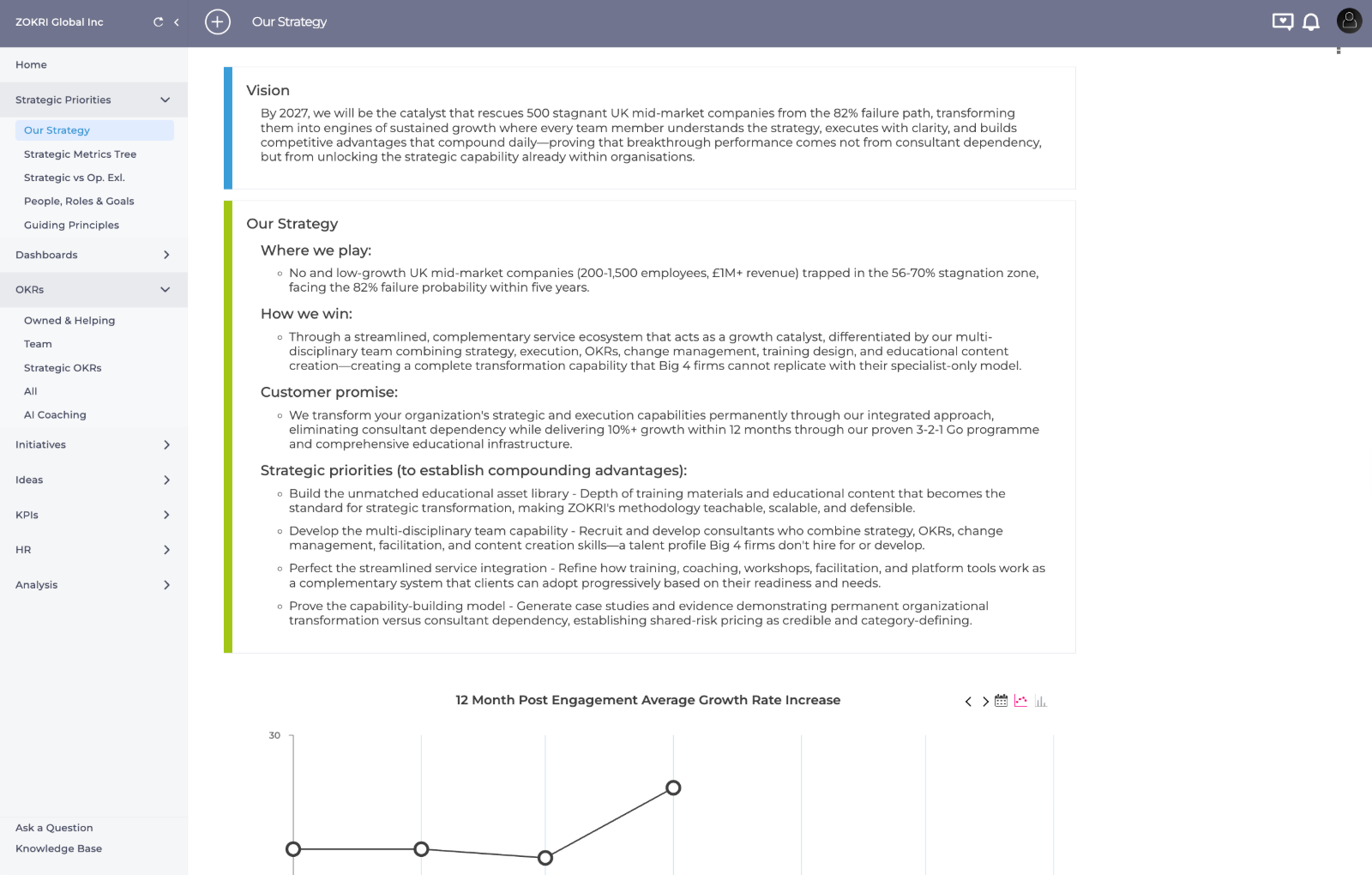
Your strategy on one page. Connected to everything.
The diagnosis, the choices you've made, where you will and won't play, and your north star metric: the one number that shows whether the strategy is working. All in one place everyone can read.
It isn't a slide that gets filed. Every measure, goal, idea and team plan below links back to it, so people can see how their work moves the strategy.
Direction · Measures
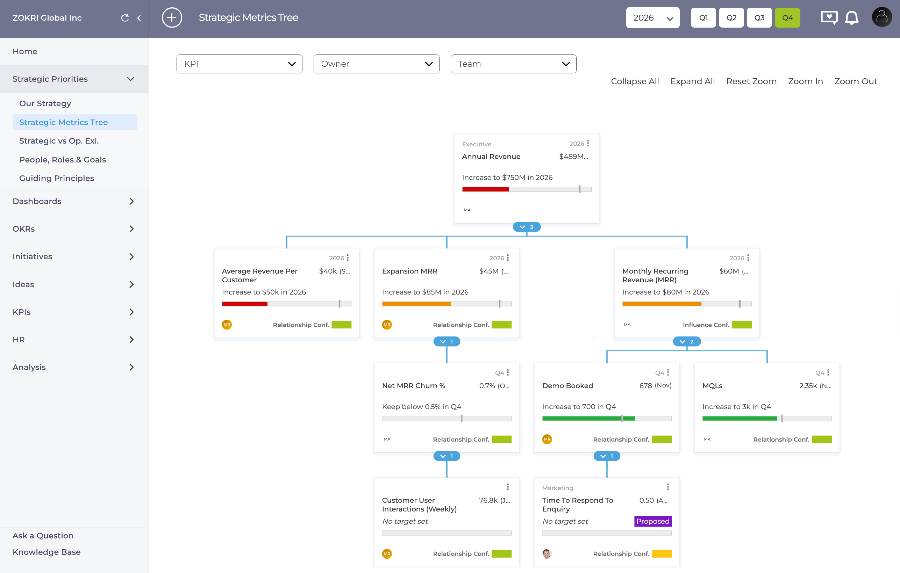
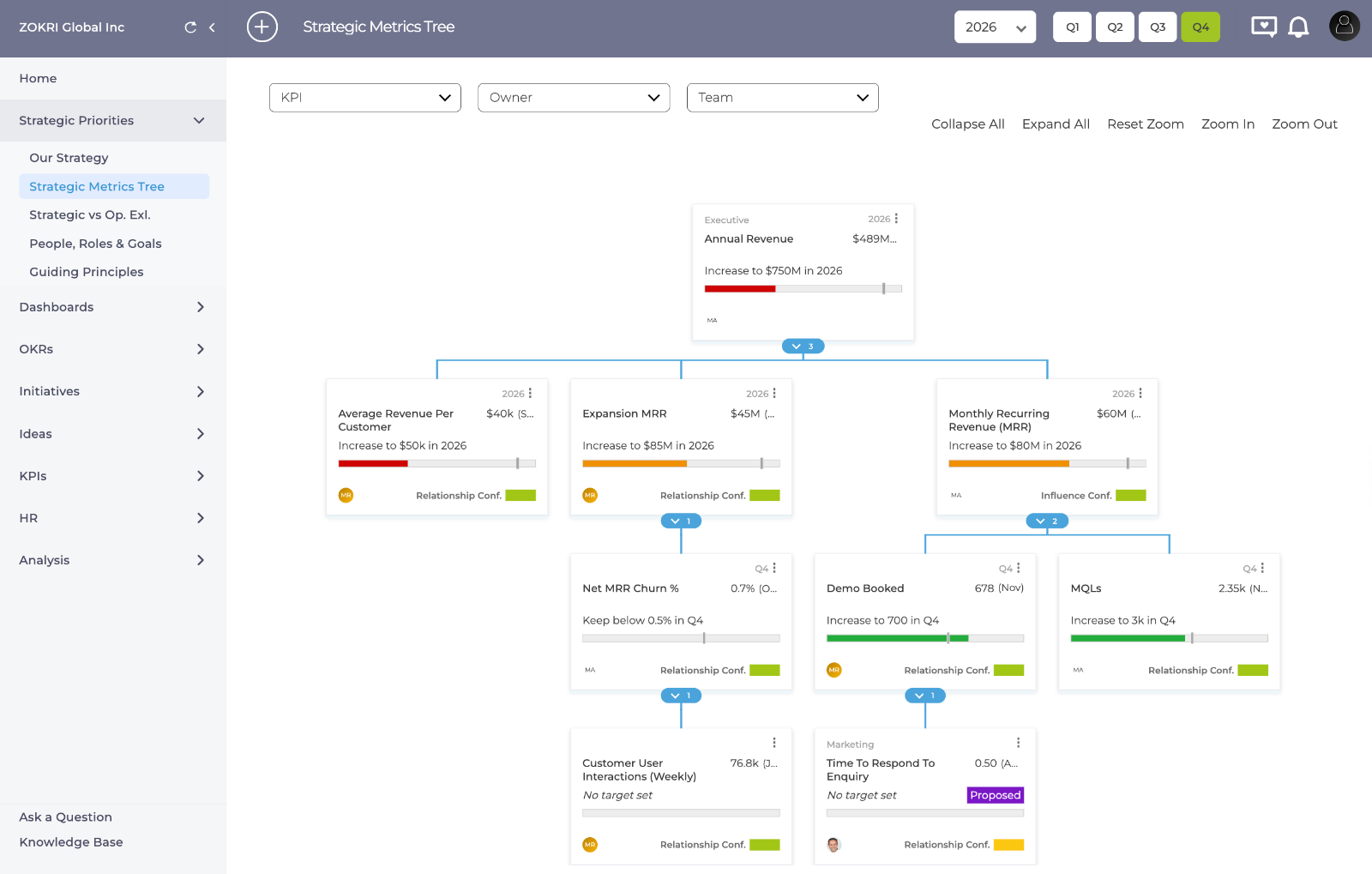
See what drives every number.
Each measure sits under the one it drives, from annual revenue down to the everyday numbers teams can move.
Every one has a target, an owner and a confidence rating on how strongly it moves the number above, so you can see where effort pays off and where the link is only a hope.
Direction · Goals
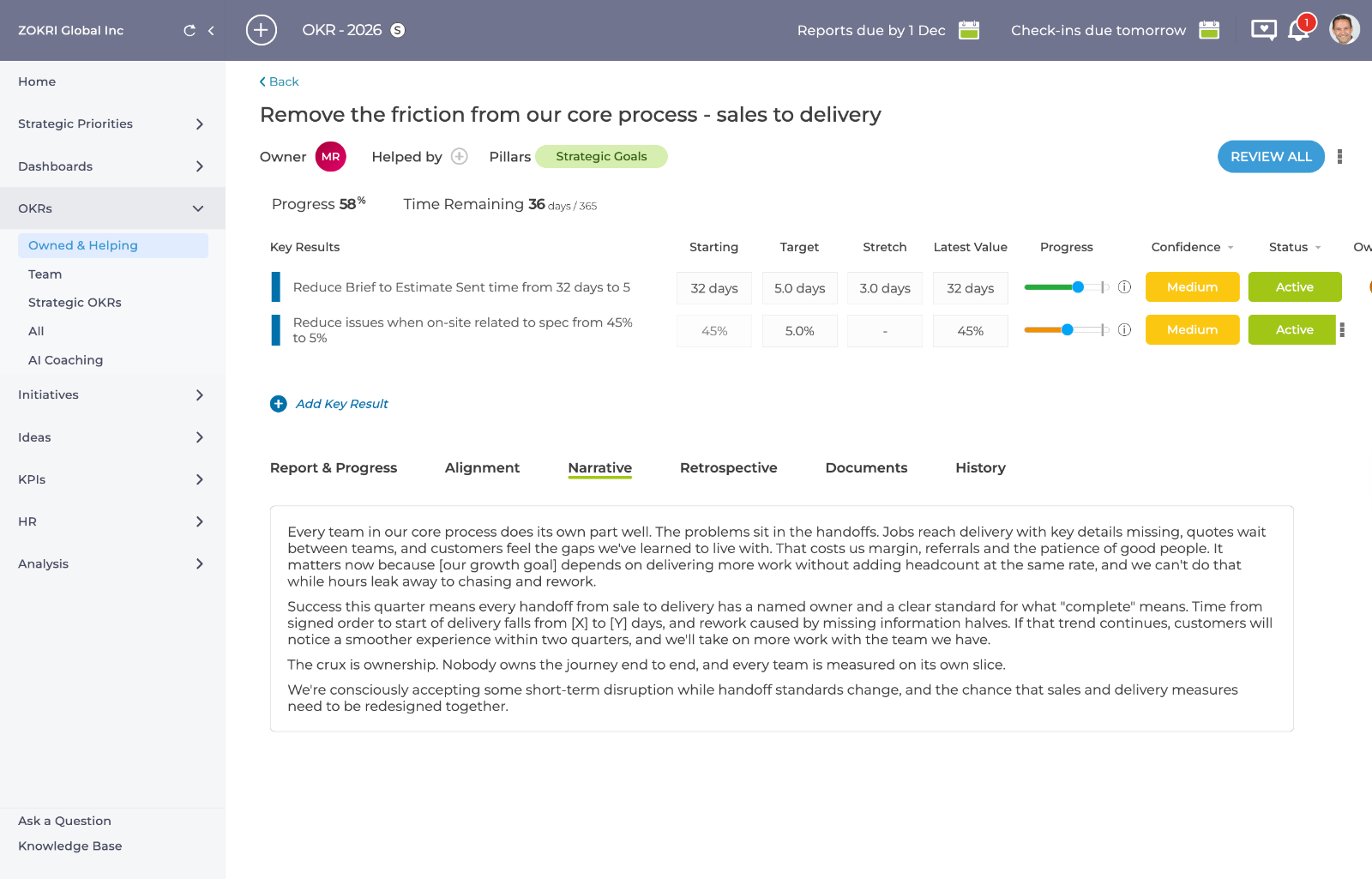
Goals people can explain, and actually move.
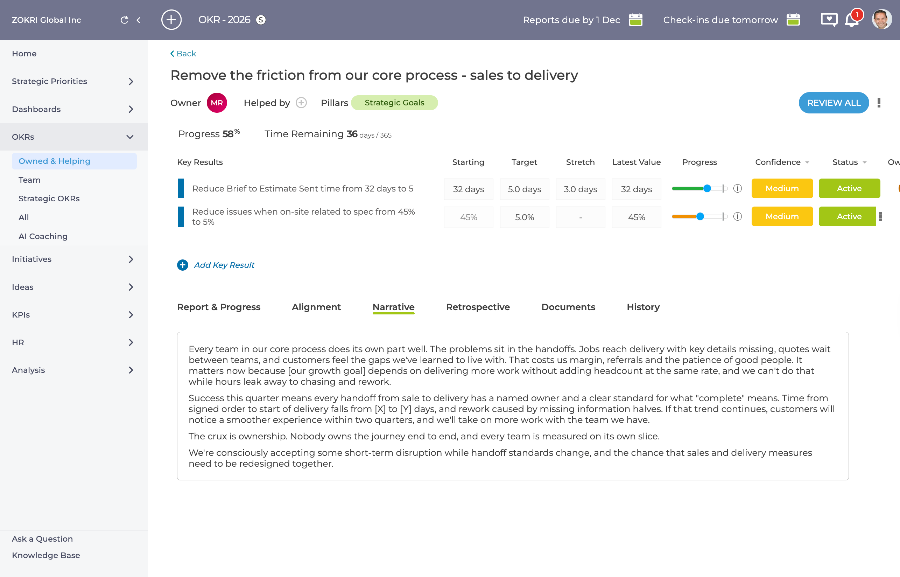
Every goal has an owner, key results with a starting point, target and stretch, and a weekly read on progress, confidence and status.
Behind each one sits a narrative: why it matters now, what success looks like, the crux, and the trade-offs you're choosing to accept. Alignment, retrospectives and documents live alongside it, and the AI coach checks every goal before it goes live.
It checks the foundations before it writes a word.
It checks every goal against your operating model, not just against the rules for writing a good Key Result.
Ask a generic chatbot to write an Objective narrative and it writes one. Ask ours, and it flags what's missing first, themes, Key Result context, initiative detail, because a narrative built on gaps is a narrative that won't hold up in the review.
New teams reach their first real outcome without needing us · 2026-Q3
Great, let's build out the Objective Narrative. Before I draft anything, I want to flag where this OKR currently stands structurally, since a strong narrative needs to sit on top of solid foundations.
MISSING OR INCOMPLETE RIGHT NOW
- ●Objective narrative (empty)
- ●Themes (none selected)
- ●Key Result context for all three KRs (empty, though target confidence is set)
- ●Initiative context for "Improve onboarding workflow" (empty)
We can come back to those, but let's focus on the narrative since that's what you asked for.
A good Objective Narrative needs to answer four things, and I'd like to co-create it with you rather than just write it myself, so it reflects your actual reasoning and evidence.
- 1.Why now / urgency, and how it connects to the top-level Objective it sits under
- 2.Definition of success, near-term and if the trend continues
- 3.The crux: the single hardest part of solving this
- 4.Risks you're consciously accepting
Once you share your thinking, I'll shape it into a tight, well-structured narrative and load it into the OKR workspace.
Direction · Strategy vs business as usual
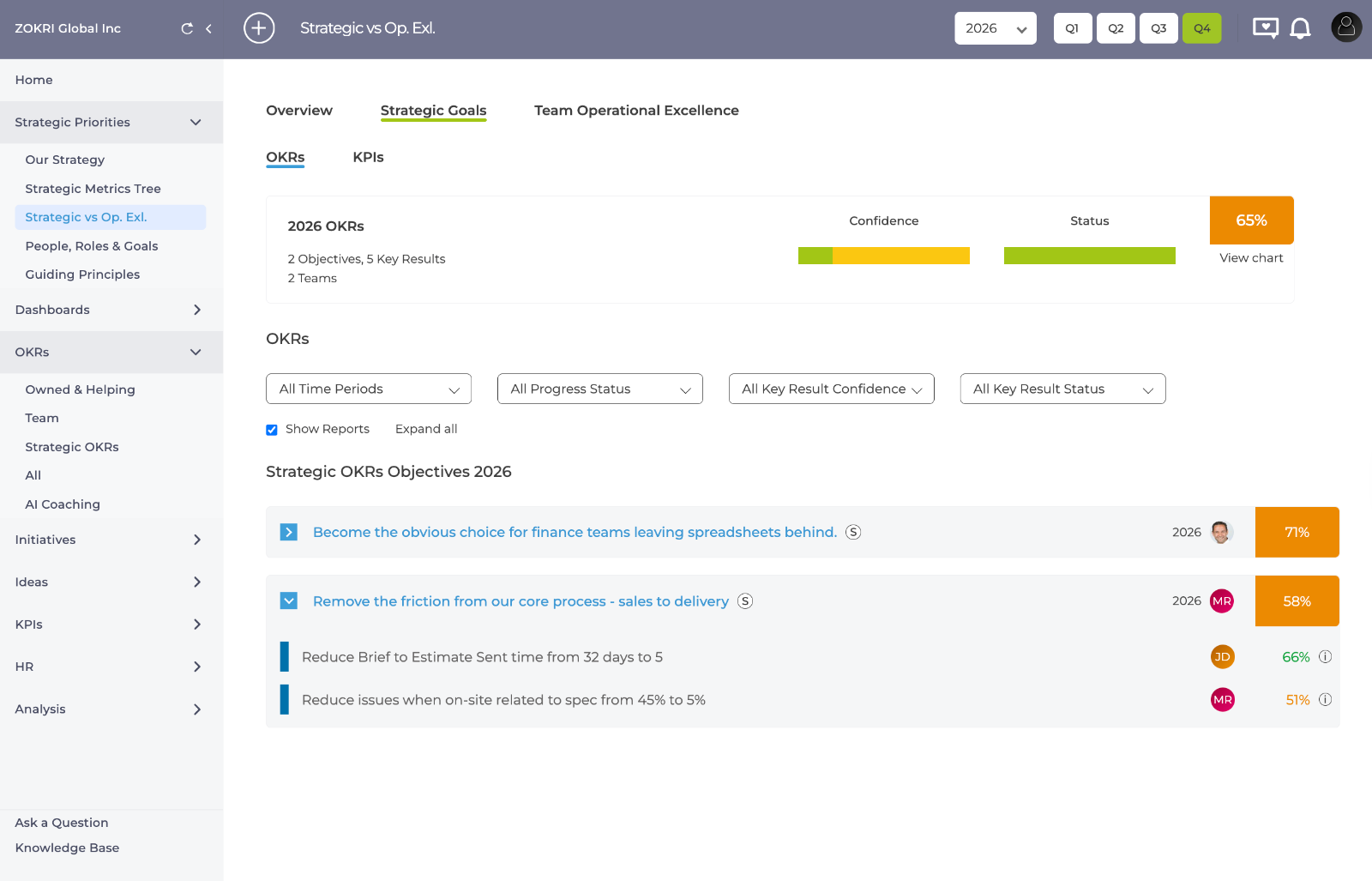
See how much of your week is moving the business forward.
Most teams spend nearly all their time keeping the lights on, and the strategy gets whatever's left.
Team Scorecards give business as usual its own home, so strategic goals stay reserved for the work that changes things. For the first time, you can see the split, team by team, and do something about it.
Also: Ideas
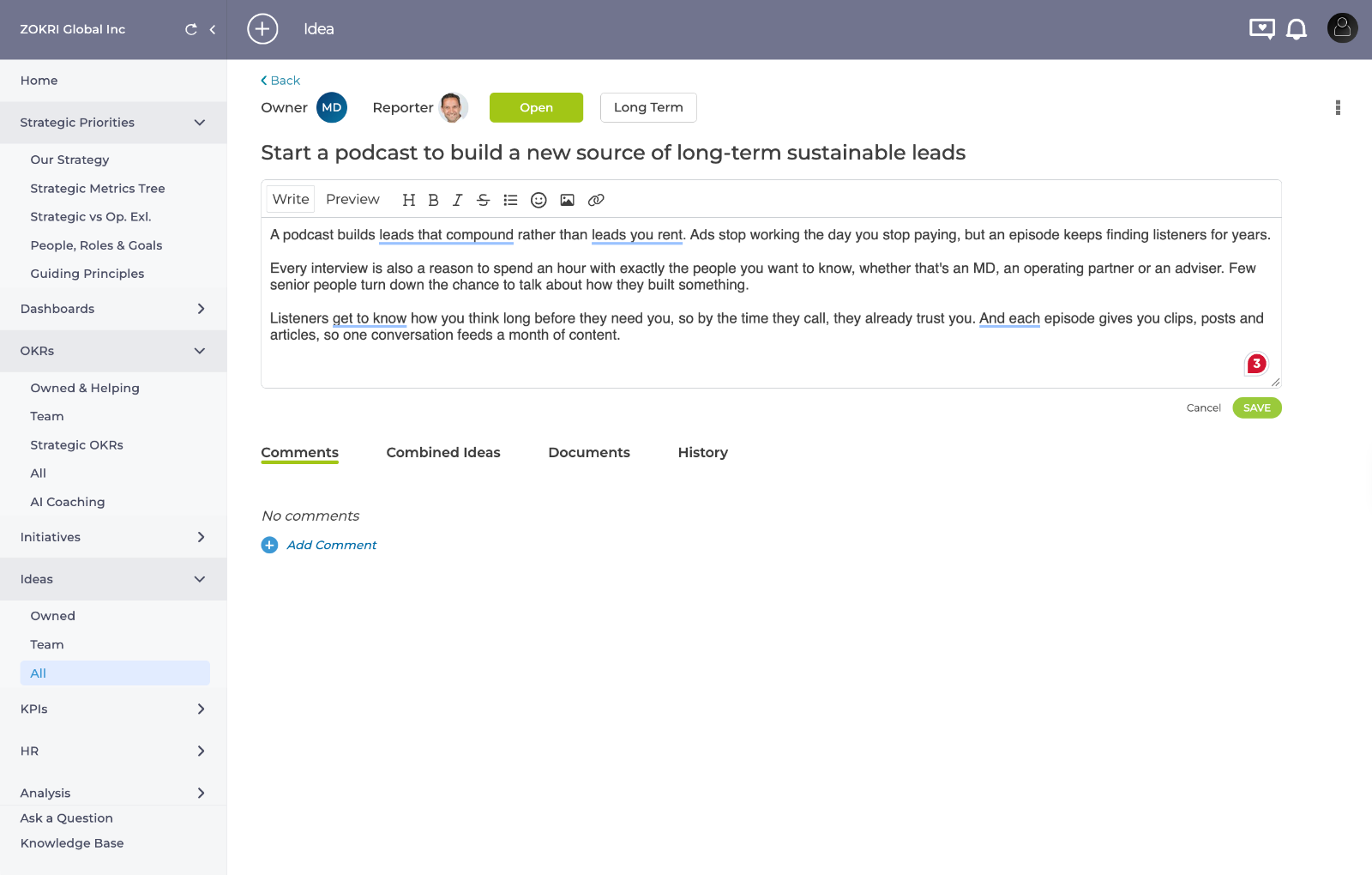
Good ideas don't wait for the next away day.
Anyone can capture an idea the moment they have it, whether it improves how the business runs, sharpens business as usual or moves a strategic goal.
Job 2 of 4
Organise around it
BeforeRoles drift, decisions bounce up to the top, and nobody owns the handoffs.
AfterEvery role shows what it owns, what it decides and how it is going.
Organisation · Roles and decisions
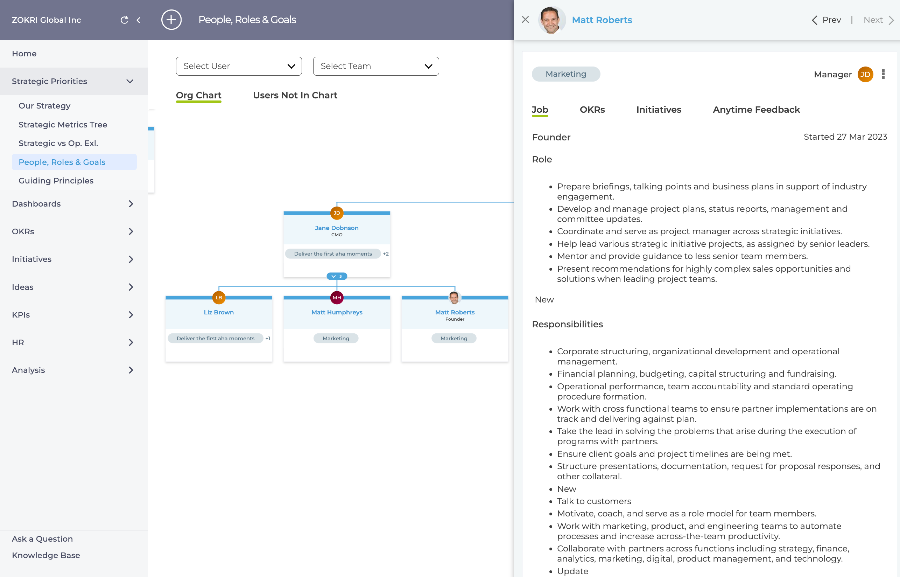
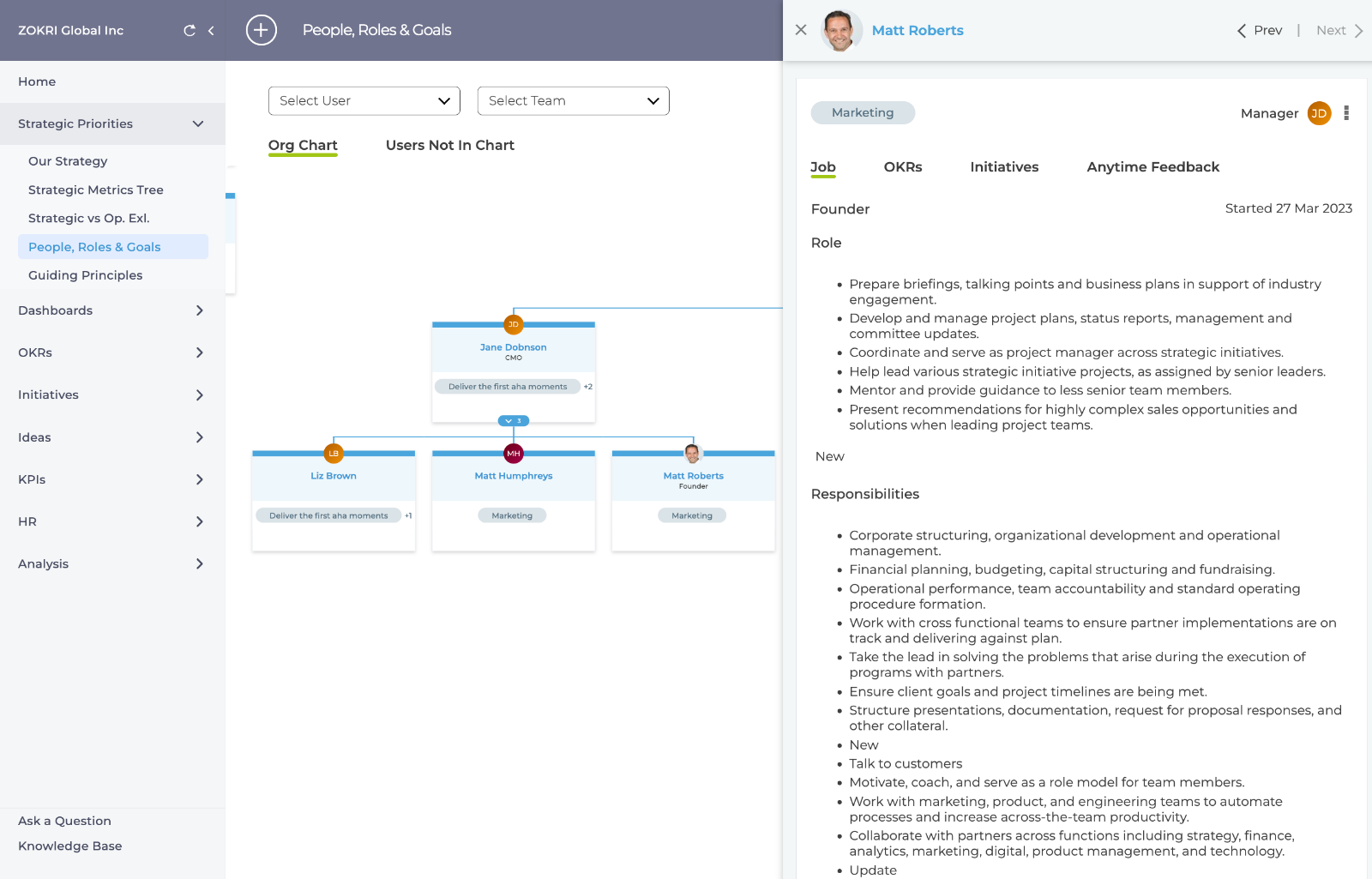
Click any role. See what it owns, what it decides and how it's going.
One screen shows a role's goals, its KPIs, the decisions it makes and the customer journey it's responsible for. Most leaders have never seen their business laid out like that.
It's also the fastest way to spot work nobody owns, decisions with three owners, and good people carrying far too much.
Job 3 of 4
Run the rhythm
BeforeUpdates are chased by email, and problems surface at the quarter end.
AfterA weekly habit that updates progress, wellbeing and reports at once.
Rhythm · Check-ins and wellbeing
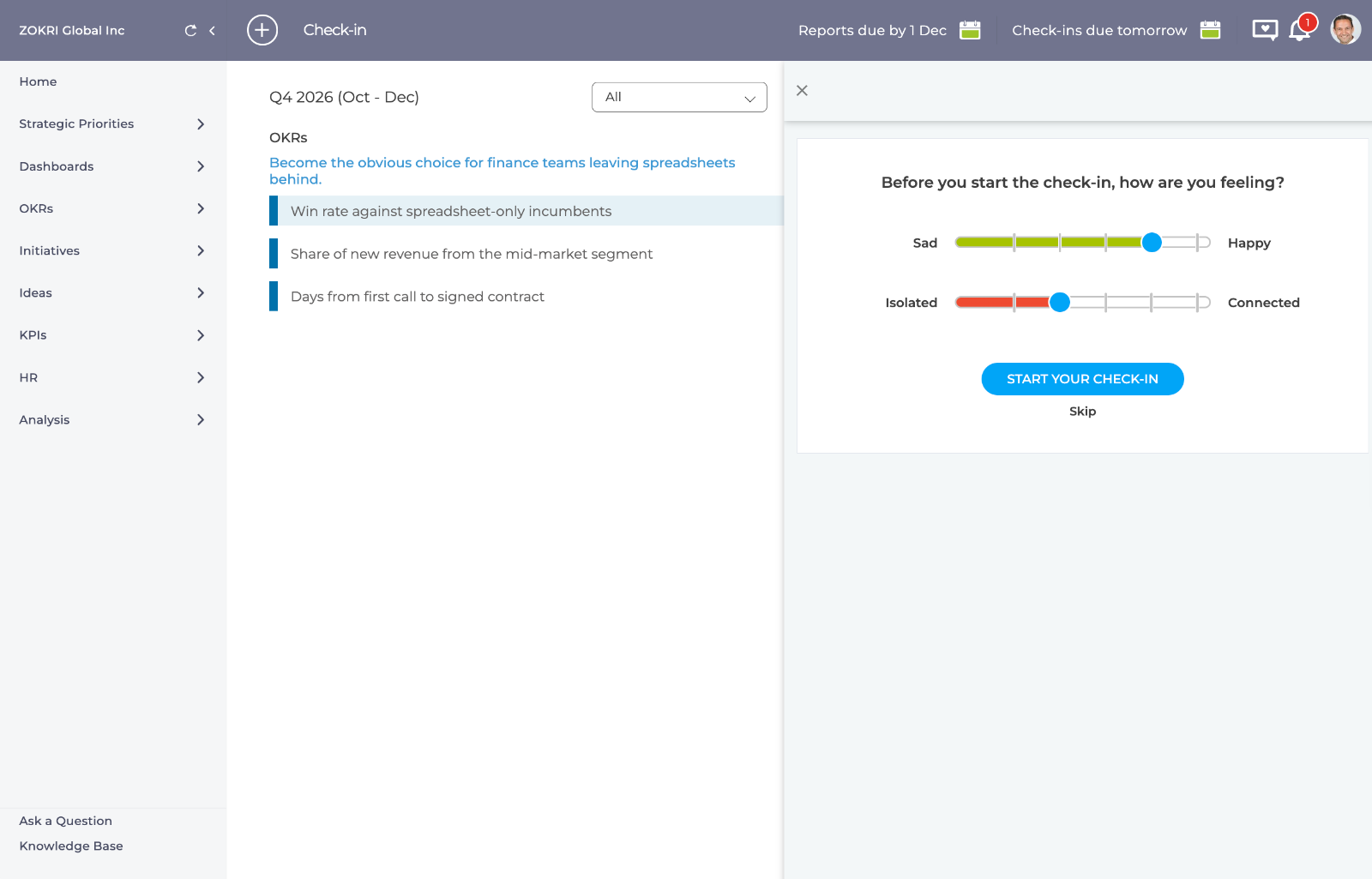
Know how your people are doing before they tell a recruiter.
Every goal check-in starts with a quick read on how people are feeling. The same weekly habit updates progress, feeds your reports and shows where the load is heavy and where people are running out of room.
Your staff feel a misfiring system long before it shows up in your customer numbers or your board pack. Now you can see it too, and act while it's still cheap to fix.
Also: Reporting
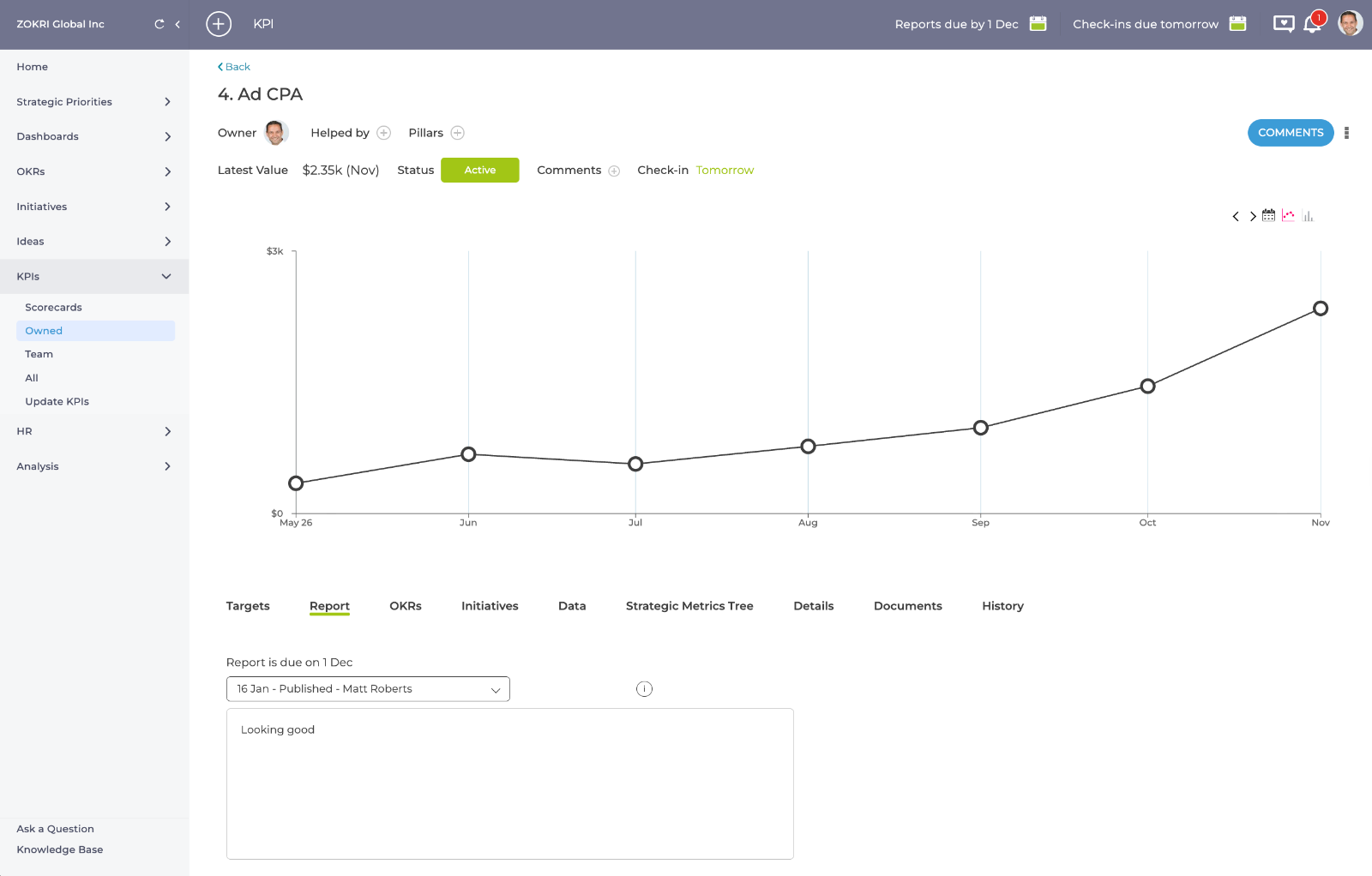
Reports that arrive without anyone chasing.
Schedule goal and KPI updates once. Every owner gets a reminder and a notification when their check-in or report is due, and sees it at the top of every screen until it's done.
Job 4 of 4
Shape the culture
BeforeThe values are on the wall and nobody can say what they look like.
AfterBehaviours people can name, notice and recognise in each other.
Culture · Guiding principles
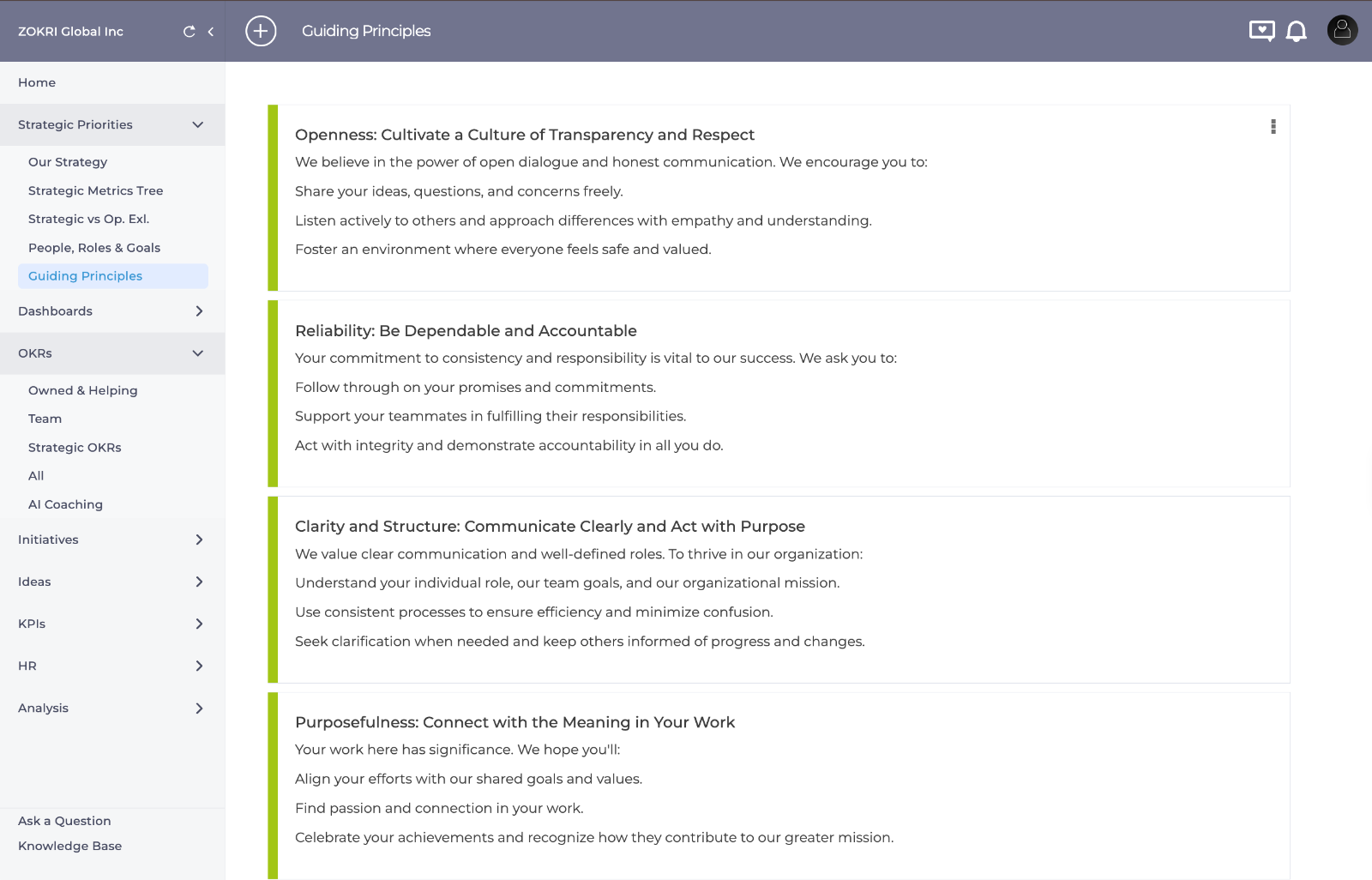
Values people live, not just read.
Your values and guiding principles sit in the same system as your goals and roles, written as behaviours people can recognise.
When someone lives one, colleagues can recognise them for it. The behaviour you want becomes the behaviour that gets noticed, and the culture you describe starts to match the one people feel.
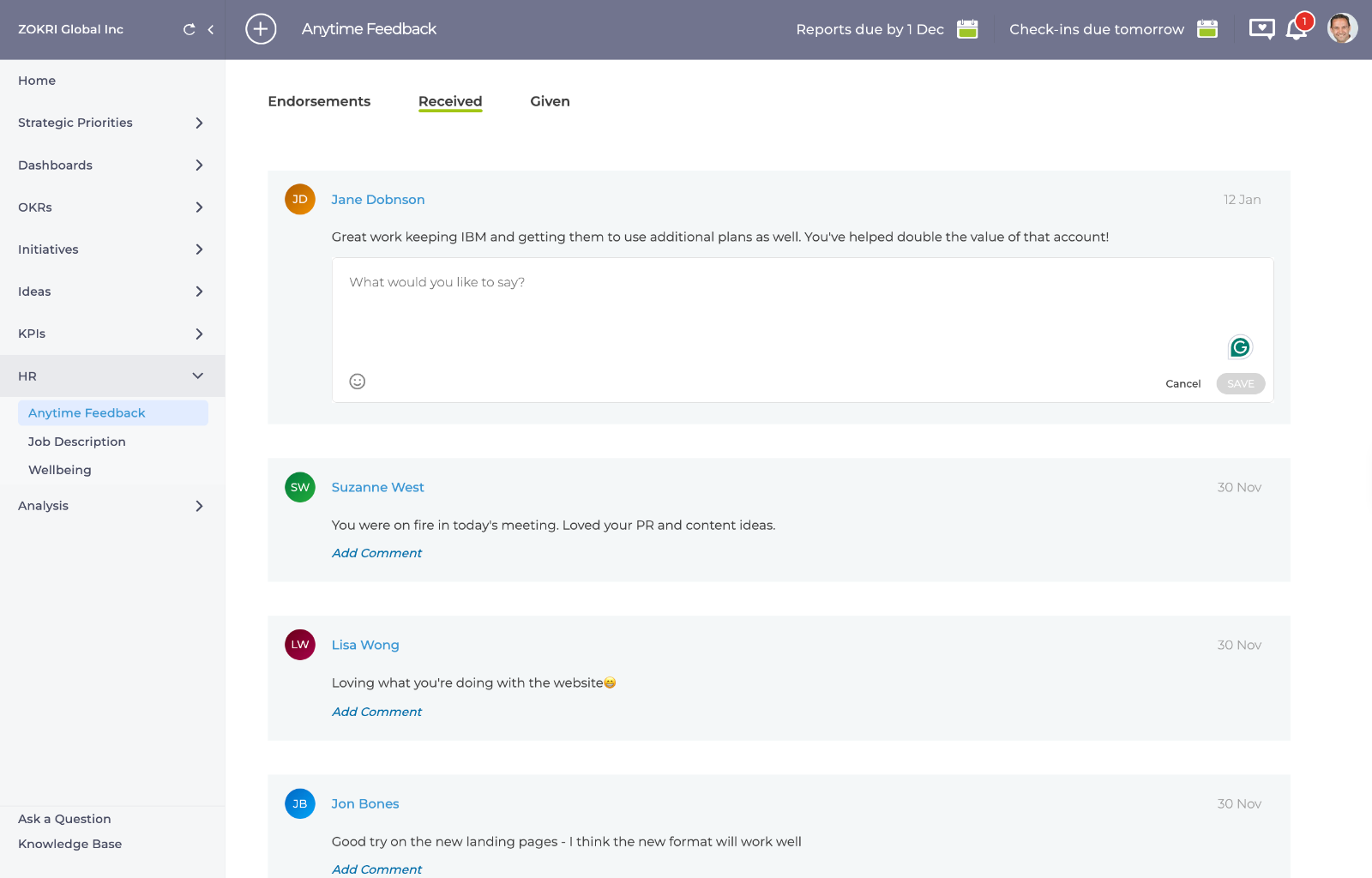
Also: Feedback and recognition
Feedback in the moment, not at the annual review.
Anyone can give feedback or recognise a colleague the moment it matters, and the person can reply.
Design it, then run it
Designed with experts. Run by your team.
Most businesses need two things: help designing how they should run, and a system that keeps it running. We do both.
A small senior team of people who've made a career of these moments designs it with you, for about the cost of one full-time hire, for one to twelve months, starting in weeks. Then it lives in ZOKRI, so the capability stays when we leave.
Design with us
- Listen
- Diagnose
- Decide
- Design
Run it in ZOKRI
Pricing
Strategy, goals, KPIs, roles, decisions, capabilities, check-ins and reporting in one system, with optional AI coaching.
- ✓Strategy, goals, KPIs and roles connected
- ✓Integrations: Google Docs, Slack, Jira
- ✓Automated progress tracking from your metrics
- ✓Simple desktop and mobile interface
- ✓AI coach trained on your context
Everything in Business OS, plus a small senior team who design your operating model with you and set it up in ZOKRI.
- ✓Everything in Business OS
- ✓A small senior team designs your operating model with you
- ✓Custom AI coach trained on your context
- ✓Standard and custom integrations
- ✓Set up in ZOKRI, so it keeps running when we leave
Customers stay a long time for great reasons
At AtlasCloud we were looking for a platform to implement OKRs, to give our employees clarity on the strategic direction of the business and how they could contribute or influence it. Since implementing ZOKRI we've started to see the expected benefits, and many more we didn't anticipate. ZOKRI facilitates important conversations that people weren't necessarily having before, removing roadblocks to progress, providing clarity of prioritisation and improving collaboration across our business. The platform's implementation was very smooth, and ZOKRI's ongoing support has been excellent.

Questions people ask
Is this target operating model software?
Yes, in the sense that matters. A target operating model describes how your business should run: strategy, goals, roles, decisions, processes and measures. ZOKRI is where that description lives and runs, week to week. If you need help designing it first, see how we design target operating models.
Do we have to use OKRs?
No. Use OKRs, WIGs, Rocks or SMART goals. The system stays the same.
Does it replace our HR system?
No. It shows how work is organised and decided, not payroll or contracts.
Why not a spreadsheet and some slides?
Because they go stale. The model drifts from reality and nobody notices until a board or buyer asks.
We're a large, multi-division organisation. Does it scale?
Yes. See OKR implementation for large companies.
See your business as a system.
A 45-minute walkthrough of how ZOKRI connects strategy, roles, goals and the rhythm that runs them. If it fits, we'll set up a proof of concept with your own strategy and structure.
Book a walkthrough Not ready to talk? Explore a sample business