





Free to access Strategy and Execution Masterclasses and Deepdives + Peer communities for Leaders, Business Owners, and Founders with a growth mandate.
Hurry, For A Limited Time, The Community Is FREE To Join, And Will Be Free For Life To New Members
Learn how to diagnose your organisation, make smarter strategic decisions, and build a clear, data-driven plan that drives sustainable growth.
This briefing is your blueprint for planning and executing this diagnostic phase. Not a checklist to get through, but a strategic approach to building understanding and trust simultaneously. Because in your first 90 days, those two things, understanding the organisation deeply and building enough trust that people will follow you through difficult changes, are really the same work, and sustaining momentum well beyond the initial transition period.
This briefing is your blueprint for systematically, rigorously, and efficiently incorporating an external perspective into your diagnosis, within your compressed timeline and high-stakes early decision-making environment. We’ll cover four major research approaches: Customer Discovery, Competitor Research, Market Intelligence, and AI-Powered Deep Research, and how to apply each with clarity, speed, and practical impact from day one onward immediately.
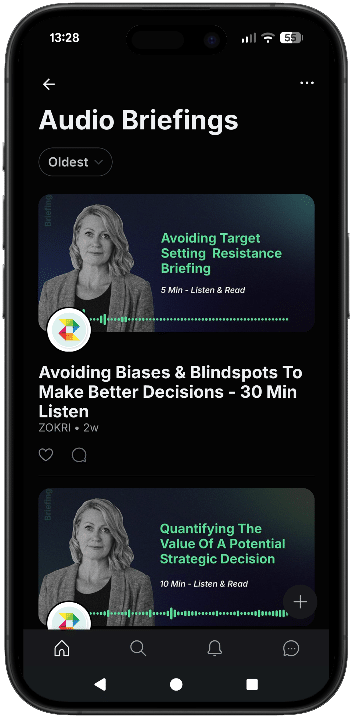
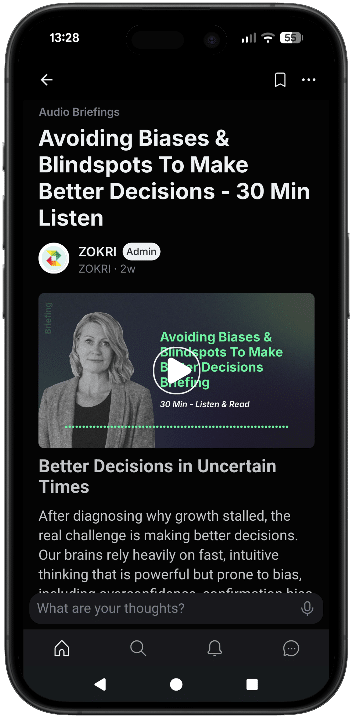
This briefing is your guide to decision-making reality, covering how your brain works when making decisions (System 1 vs System 2), the cognitive biases dangerous for leaders, and the distinction between belief and fact and why confidence calibration matters. We’ll explore practices for optimising decision-making, building judgment, and how to balance analysis and intuition without overthinking or under-thinking, before finishing with how to create systems that work with psychology, not against it.
Think about the last time you chose between investing in a new market segment versus doubling down on your core. Did you have a systematic way to compare them? Or did it come down to your gut feeling about which exec made the compelling case? What you’re about to hear is a system for putting numbers on strategic choices. Not financial projections, those are guesses dressed up in spreadsheets. This is about quantifying confidence, value, timing, and strategic fit before you commit scarce resources.
You’ve listened inside your organisation, gathered external perspectives from customers and competitors, analysed market data, and built better decision-making practices. You understand the problems and the opportunities. You’ve learned to recognise your cognitive biases and catch yourself when System 1 thinking leads you astray. Now comes the hardest decision-making: formulating a strategy under uncertainty, pressure, incomplete information, and irreversible long-term consequences.
Analytical capability is how organisations move from reactive firefighting to systematic capability building. Companies that break through growth plateaus build infrastructure revealing causal drivers rather than correlations. That understanding lets you allocate scarce resources to what accelerates growth. The same infrastructure provides predictive power (seeing problems before revenue impact), tracks whether strategies are working, and maintains organisational health through early warning systems.
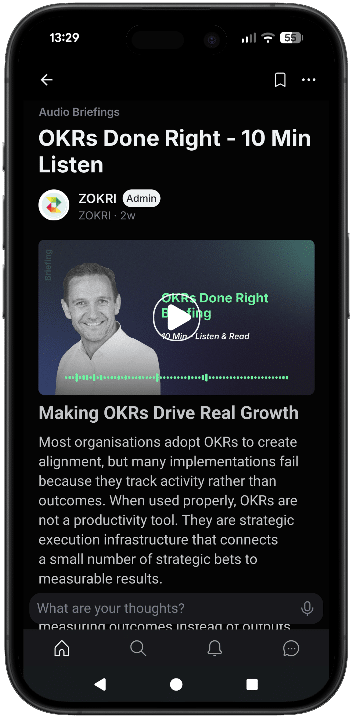
Implement OKRs the right way to align teams, enable ownership, and turn strategy into measurable execution and results.
This briefing presents ZOKRI’s OKR implementation methodology. Built over a decade of hands-on work with growth companies. Refined across hundreds of implementations across diverse industries, leadership teams, and organisational maturity levels worldwide. Designed not from theory, but from practice. What follows is the system that makes OKRs strategic rather than cosmetic, and capable of driving measurable, sustained organisational performance improvement.
If you’re cascading OKRs from company → department → team → individual, you’re fundamentally misunderstanding what OKRs are designed to do. Most OKR implementations don’t fail because OKRs are flawed. They fail because companies force OKRs through an org-chart cascade that kills the very thing OKRs are meant to create: Strategic alignment with team agency, ownership, adaptability, and genuine execution commitment across the organisation.
When leadership teams begin talking about developing metric trees and using OKRs with outcomes as Key Results, they are also talking about target setting, and when they do, something subtle happens. People don’t lean in with excitement. They tense up. Not because they’re lazy. Not because they resist accountability. But because, often through painful experience, they’ve learned that targets become weapons used against them later unfairly.
In this briefing we’ll explore why functional structures create bottlenecks at scale, how to organise around value streams rather than functions, when teams should collaborate versus work independently, how to manage cognitive load so teams can focus, and what organisational transformation actually requires from leadership, structure, incentives, governance, talent allocation, decision rights, and sustained behavioural change over time.
Design your Business Operating System to improve focus, align incentives, enable experimentation, and turn strategy into consistent high performance.
Every company operates through systems, whether deliberately designed or accumulated. Strategies are documented, budgets guide spending, and goals are set quarterly. Functional processes direct daily work. Teams develop their own rhythms and rituals. These aren’t isolated activities. They’re the interconnected components of your Business Operating System (OS): the architecture that channels your organisation’s collective time, skills, and capabilities towards outcomes.
The mathematics is stark. Research shows that most knowledge workers average about three hours of genuinely productive work per eight-hour day. If you could increase that to even four hours daily, you’d gain the equivalent of adding 20 people for every 100 employees, without hiring anyone new at all, dramatically improving organisational throughput and overall execution effectiveness. Not through heroic effort or longer hours. Simply by reducing the cognitive costs of how we structure work.
The companies that grow quickly operate differently. They’ve built an “experimentation mindset”: a systematic approach to running smaller, faster tests that accelerate learning and reduce the cost of being wrong. Instead of betting big on assumptions, they create capabilities to test, learn, and adapt at speed. This capability isn’t about reducing rigour or accepting chaos. It’s about redirecting organisational energy from defending assumptions to systematically testing them.
Here’s the uncomfortable question that hangs in the air: If we stopped all this reporting tomorrow, what would we actually do differently? For most organisations, the honest answer is: not many things. Yet we can’t seem to stop. We create ever-more elaborate dashboards. We implement new reporting tools. We add reporting layers. And somehow, it still feels like waste, compliance theatre rather than value creation. What’s happening here?
Here’s what we see: companies change their strategy but forget to change what they’re paying people to do. Then leadership wonders why execution stalls, why collaboration doesn’t materialise, and why innovation remains theatrical rather than real. The problem isn’t that people don’t understand the strategy. The problem is you’re financially incentivising them to ignore it, through misaligned metrics, rewards, promotions, and performance management systems.
Middle managers are critical infrastructure. They translate strategy into action. They develop talent that executes plans. They’re the layer that makes or breaks your ability to move faster than the competition. Yet poor management costs UK employers £84 billion annually in lost productivity. When managers get it right, the impact is transformative. Gallup’s research shows that manager quality accounts for 70% of the variance in team engagement, which correlates with productivity, retention, and results.
Lead change effectively by building psychological safety, reducing resistance, and enabling teams to adapt and execute with confidence.
This article examines change management through three complementary frameworks. David Rock’s SCARF model maps the five social domains that trigger threat or reward responses. William Bridges’ transition model explains why change creates a psychological journey that cannot be skipped or rushed. Edgar Schein’s work on culture reveals why surface changes often fail and how “humble inquiry” enables genuine transformation.
This briefing explores research from three experts who’ve studied this dynamic for decades: Amy Edmondson’s foundational work on psychological safety in teams, Timothy Clark’s four-stage framework for progressively building it, and Brené Brown’s research on vulnerability and courage in leadership. Together, their work reveals what psychological safety actually is, why it directly impacts execution velocity, and how leaders can build it without sacrificing performance standards.
Learn how to diagnose your organisation, make smarter strategic decisions, and build a clear, data-driven plan that drives sustainable growth.
This briefing is your blueprint for planning and executing this diagnostic phase. Not a checklist to get through, but a strategic approach to building understanding and trust simultaneously. Because in your first 90 days, those two things, understanding the organisation deeply and building enough trust that people will follow you through difficult changes, are really the same work, and sustaining momentum well beyond the initial transition period.
This briefing is your blueprint for systematically, rigorously, and efficiently incorporating an external perspective into your diagnosis, within your compressed timeline and high-stakes early decision-making environment. We’ll cover four major research approaches: Customer Discovery, Competitor Research, Market Intelligence, and AI-Powered Deep Research, and how to apply each with clarity, speed, and practical impact from day one onward immediately.
This briefing is your guide to decision-making reality, covering how your brain works when making decisions (System 1 vs System 2), the cognitive biases dangerous for leaders, and the distinction between belief and fact and why confidence calibration matters. We’ll explore practices for optimising decision-making, building judgment, and how to balance analysis and intuition without overthinking or under-thinking, before finishing with how to create systems that work with psychology, not against it.
Think about the last time you chose between investing in a new market segment versus doubling down on your core. Did you have a systematic way to compare them? Or did it come down to your gut feeling about which exec made the compelling case? What you’re about to hear is a system for putting numbers on strategic choices. Not financial projections, those are guesses dressed up in spreadsheets. This is about quantifying confidence, value, timing, and strategic fit before you commit scarce resources.
You’ve listened inside your organisation, gathered external perspectives from customers and competitors, analysed market data, and built better decision-making practices. You understand the problems and the opportunities. You’ve learned to recognise your cognitive biases and catch yourself when System 1 thinking leads you astray. Now comes the hardest decision-making: formulating a strategy under uncertainty, pressure, incomplete information, and irreversible long-term consequences.
Analytical capability is how organisations move from reactive firefighting to systematic capability building. Companies that break through growth plateaus build infrastructure revealing causal drivers rather than correlations. That understanding lets you allocate scarce resources to what accelerates growth. The same infrastructure provides predictive power (seeing problems before revenue impact), tracks whether strategies are working, and maintains organisational health through early warning systems.
Implement OKRs the right way to align teams, enable ownership, and turn strategy into measurable execution and results.
This briefing presents ZOKRI’s OKR implementation methodology. Built over a decade of hands-on work with growth companies. Refined across hundreds of implementations across diverse industries, leadership teams, and organisational maturity levels worldwide. Designed not from theory, but from practice. What follows is the system that makes OKRs strategic rather than cosmetic, and capable of driving measurable, sustained organisational performance improvement.
If you’re cascading OKRs from company → department → team → individual, you’re fundamentally misunderstanding what OKRs are designed to do. Most OKR implementations don’t fail because OKRs are flawed. They fail because companies force OKRs through an org-chart cascade that kills the very thing OKRs are meant to create: Strategic alignment with team agency, ownership, adaptability, and genuine execution commitment across the organisation.
When leadership teams begin talking about developing metric trees and using OKRs with outcomes as Key Results, they are also talking about target setting, and when they do, something subtle happens. People don’t lean in with excitement. They tense up. Not because they’re lazy. Not because they resist accountability. But because, often through painful experience, they’ve learned that targets become weapons used against them later unfairly.
In this briefing we’ll explore why functional structures create bottlenecks at scale, how to organise around value streams rather than functions, when teams should collaborate versus work independently, how to manage cognitive load so teams can focus, and what organisational transformation actually requires from leadership, structure, incentives, governance, talent allocation, decision rights, and sustained behavioural change over time.
Design your Business Operating System to improve focus, align incentives, enable experimentation, and turn strategy into consistent high performance.
Every company operates through systems, whether deliberately designed or accumulated. Strategies are documented, budgets guide spending, and goals are set quarterly. Functional processes direct daily work. Teams develop their own rhythms and rituals. These aren’t isolated activities. They’re the interconnected components of your Business Operating System (OS): the architecture that channels your organisation’s collective time, skills, and capabilities towards outcomes.
The mathematics is stark. Research shows that most knowledge workers average about three hours of genuinely productive work per eight-hour day. If you could increase that to even four hours daily, you’d gain the equivalent of adding 20 people for every 100 employees, without hiring anyone new at all, dramatically improving organisational throughput and overall execution effectiveness. Not through heroic effort or longer hours. Simply by reducing the cognitive costs of how we structure work.
The companies that grow quickly operate differently. They’ve built an “experimentation mindset”: a systematic approach to running smaller, faster tests that accelerate learning and reduce the cost of being wrong. Instead of betting big on assumptions, they create capabilities to test, learn, and adapt at speed. This capability isn’t about reducing rigour or accepting chaos. It’s about redirecting organisational energy from defending assumptions to systematically testing them.
Here’s the uncomfortable question that hangs in the air: If we stopped all this reporting tomorrow, what would we actually do differently? For most organisations, the honest answer is: not many things. Yet we can’t seem to stop. We create ever-more elaborate dashboards. We implement new reporting tools. We add reporting layers. And somehow, it still feels like waste, compliance theatre rather than value creation. What’s happening here?
Here’s what we see: companies change their strategy but forget to change what they’re paying people to do. Then leadership wonders why execution stalls, why collaboration doesn’t materialise, and why innovation remains theatrical rather than real. The problem isn’t that people don’t understand the strategy. The problem is you’re financially incentivising them to ignore it, through misaligned metrics, rewards, promotions, and performance management systems.
Middle managers are critical infrastructure. They translate strategy into action. They develop talent that executes plans. They’re the layer that makes or breaks your ability to move faster than the competition. Yet poor management costs UK employers £84 billion annually in lost productivity. When managers get it right, the impact is transformative. Gallup’s research shows that manager quality accounts for 70% of the variance in team engagement, which correlates with productivity, retention, and results.
Lead change effectively by building psychological safety, reducing resistance, and enabling teams to adapt and execute with confidence.
This article examines change management through three complementary frameworks. David Rock’s SCARF model maps the five social domains that trigger threat or reward responses. William Bridges’ transition model explains why change creates a psychological journey that cannot be skipped or rushed. Edgar Schein’s work on culture reveals why surface changes often fail and how “humble inquiry” enables genuine transformation.
This briefing explores research from three experts who’ve studied this dynamic for decades: Amy Edmondson’s foundational work on psychological safety in teams, Timothy Clark’s four-stage framework for progressively building it, and Brené Brown’s research on vulnerability and courage in leadership. Together, their work reveals what psychological safety actually is, why it directly impacts execution velocity, and how leaders can build it without sacrificing performance standards.
Currently Free for Life to New Members
We want you to feel at home
New CEOs
A cohort of CEOs promoted to the role, learning on the job and under pressure to get results, often suffering with a little imposter syndrome.
Established, Long-standing CEOs
A cohort of seasoned CEOs with deep experience, operating with confidence and under pressure to sustain long-term performance.
Tech Scale-up Founders
You’ve got traction and you’re building an you now need to build and org that can scale.
CXOs/SLT
A cohort for those navigating the challenge of SLT as primary team whilst leading functions.
High-performing Middle Manager
A cohort for middle managers leading a functional team who want to be the kind of manager their team remember for the right reasons.
Strategic HR Leaders
A cohort for HR leaders tasked with aligning people, skills, capabilities and culture with strategy and the needs of the business.
Start-up Founders
You’ve had a great idea and you need to get to product market fit and meaningful traction.
Product Leaders
A cohort of Product Leaders creating product that customers love and lead growth.
GTM
A cohort where GTM leaders can talk, meet, discuss best-practices.
Strategy
A cohort for leaders tasked with formulating and executing a clear, winning strategy.
OKRs (Objectives & Key Results)
For leaders and managers using or wanting to use OKRs to drive focus, alignment, and measurable outcomes.
Data Models, KPIs & Metrics
A cohort for those that want to measure what matters, build living data models that support decision making and growth.
Experimentation & Learning
A cohort for those that want to experiment more and learn faster to drive growth.
Change-management
A cohort for leaders that want and need to manage change in order to succeed.
Coaching
Leaders and managers need to also be coaches, this cohort is where we discuss how to be a coach.
AI Enablement
A cohort to discuss AI and how to use it intelligently to create a better, faster growing company for all.
Currently Free for Life to New Members
© ZOKRI 2026 All rights reserved | Privacy Policy | Terms & Conditions | GDPR
Glen has scaled and exited several companies. He helps customers develop their strategies, use OKRs, and execute their plans.
His deep understanding of sales processes and AI enablement makes him a great fit for customers with challenges in those areas.